Here's the catch: land can appreciate, or it can sit there collecting property tax bills, insurance premiums, and financing costs for years without producing a dime of rental income. Many buyers struggle with this gap between "land is cheap" and "land is profitable."
This guide walks through how to evaluate residential land in Lubbock, covering intended use, location, zoning, infrastructure, due diligence, holding costs, financing, and your exit strategy, backed by current local and Texas data.
Key Takeaways
- Residential land in Lubbock can suit builders, resellers, rental developers, or long-term holders, each with different capital and risk needs.
- Confirm zoning, legal access, utilities, drainage, and development restrictions before writing an offer.
- Vacant land produces no rental income until a home or permitted structure is built and leased.
- Judge every deal by total ownership and development costs versus realistic resale or rental outcomes, not purchase price alone.
What Does Investing in Land for Residential Use Mean?
Investing in residential land means buying a vacant or underdeveloped parcel with the expectation of eventually building a home, reselling the lot, leasing improvements once built, subdividing where allowed, or simply holding it for future residential use. The strategy you choose should drive every other decision you make about the parcel.
Not all residential land looks the same. Consider the differences:
- Raw land: no utilities, no road improvements, often outside city limits
- Improved lots: utilities stubbed to the property line, graded, sometimes platted
- Build-ready lots: fully serviced, permitted, ready for a construction loan
- Acreage for a single home: larger tracts meant for one residence, often rural
- Larger tracts with subdivision potential: acreage that could become multiple lots, pending approval
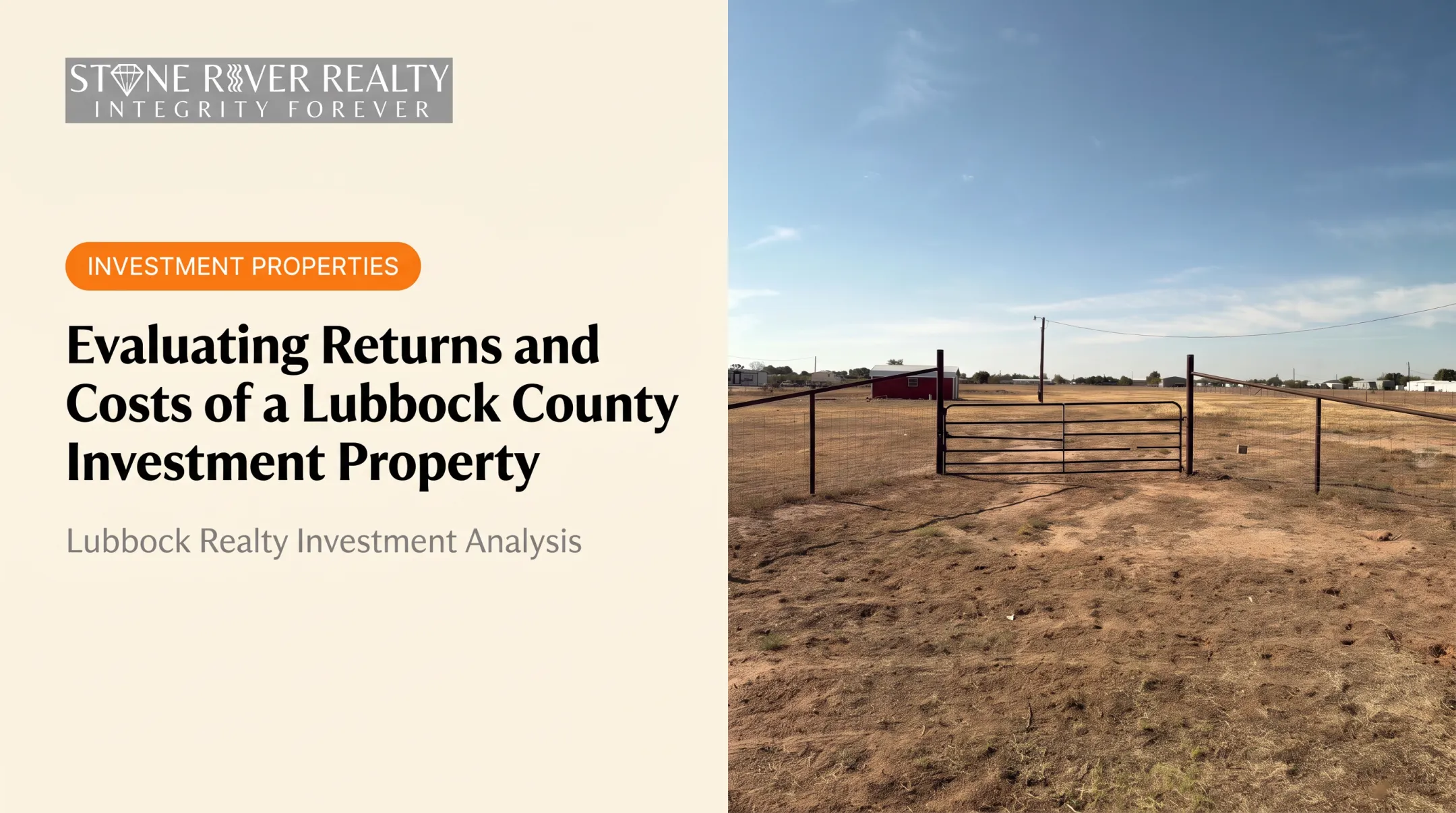
Take 9921 County Rd 6900, a 4.95-acre Lubbock tract listed at $200,000. It has highway access, electricity available, a well for water, and a septic system, along with deed restrictions against swine and junkyards. That combination works for rural homesteading or a travel-trailer setup. It would not necessarily work for a builder planning a subdivision, since the lack of municipal water and sewer service would add significant site-development cost before a multi-lot project could move forward.
The word "residential" on a listing doesn't mean the parcel is move-in or build-ready. Confirm zoning, minimum lot size, permitted structures, setbacks, access, utility availability, and subdivision rules before assuming anything about what you can legally construct.
Core Residential Investment Strategies
Four strategies cover most residential land purchases:
- Build-to-sell: construct a home, then sell it. Requires construction capital, a builder relationship, and a tight timeline to limit carrying costs.
- Build-to-rent: construct a home and hold it as a rental. Requires financing for both land and construction, plus a longer capital commitment before cash flow begins.
- Buy-and-hold for future development: purchase now, build or sell later. Lower upfront activity, but you absorb taxes and holding costs with no income offset.
- Purchase-and-resell: buy entitled or well-located land and sell it to a builder or another investor, often without ever breaking ground.

Each strategy changes your timeline, how much capital you tie up, your risk exposure, and what financing you'll qualify for. A quarter-acre infill lot like one of the six active E 76th Street parcels, each listed around $23,000 for 0.18 acres, suits a build-to-sell or build-to-rent play inside city infrastructure.
A 4.95-acre rural tract with a well and septic suits a personal homestead, but it's a poor fit for a rental subdivision without a major infrastructure investment first.
Benefits and Limitations of Investing in Residential Land
Land ownership offers real advantages:
- A tangible asset that doesn't depreciate like a structure
- Flexibility to decide what, when, and how to build
- Possible appreciation as nearby infrastructure expands
- Control over construction timing and design
But the limitations are just as real:
- No guaranteed appreciation
- Limited liquidity compared to a finished home
- Ongoing property taxes and maintenance with zero rental offset
- Uncertain development costs until engineering and utility work is confirmed
- Market demand or zoning rules can shift during your holding period
Lubbock's population growth shows the upside and the limits of this approach. The city reached 273,071 residents in 2025, a 6.2% increase from 2020, according to the Census Bureau's estimates. Lubbock County authorized 2,858 housing-unit building permits in 2025.
That growth signals real residential demand, but it doesn't prove any specific parcel will appreciate. Permit counts include apartments, and they measure authorized activity, not completed homes or guaranteed resale value for your lot.
What to Consider Before Buying Residential Investment Land in Lubbock
Before you make an offer, build a due-diligence framework that connects the parcel's physical and legal characteristics to your actual investment goal. Pull several comparable land sales or current listings, and separate asking prices from verified closed sales.
Active comparables like 1809 17th Street ($29,900 for 0.11 acres) or 3601 E 14th Street ($20,000 for 0.18 acres) are useful benchmarks, but they're list prices, not confirmed closing figures.
Location, Access, and Surrounding Development
Proximity to roads, jobs, schools, retail, and healthcare matters, but don't assume nearby growth automatically lifts your parcel's value. Verify legal and physical access: road frontage, easements, shared-driveway agreements, and whether access improvements will come out of your budget.
Lubbock has real infrastructure projects underway worth tracking. TxDOT announced a $14.8 million widening of Upland Avenue from 82nd Street to just south of 98th Street, with completion expected in spring 2028.
Separately, an annexation request covering roughly 8.82 acres near 146th Street and Frankford Avenue moved to a City Council hearing in 2025. These are published schedules and pending requests, not guaranteed outcomes. Treat them as context, not certainty.
Zoning, Subdivision, and Permitted Residential Use
Confirm current zoning, permitted residential uses, density, minimum lot size, setbacks, and the subdivision or platting process directly with the City of Lubbock Planning Department or Lubbock County Public Works for parcels outside city limits.
A few things to know going in:
- A zoning verification letter costs $50 but does not confirm code compliance or conforming use status.
- Variances require a hearing before the Zoning Board of Adjustment; a request is not an approval.
- Annexation and rezoning can take months and are never guaranteed.
- Preliminary and final plats go through the Planning and Zoning Commission before a final plat is filed with the County Clerk.
Don't treat rezoning or subdivision approval as part of your investment case until it's actually confirmed in writing.
Utilities, Water, and Development Readiness
Check whether water, sewer, electricity, gas, and internet are available at the parcel itself, not just somewhere nearby. The difference matters more than most buyers expect.
- The City of Lubbock currently charges $0 in impact fees citywide, but that doesn't eliminate the cost of building necessary infrastructure like water mains, sewer mains, or drainage.
- Electric service through LP&L requires a signed service request and plan review before scheduling. South Plains Electric Cooperative covers the first $2,500 of new-service construction, with costs above that billed to the member.
- Atmos Energy handles natural gas connections through its Builder Portal.
- Parcels without municipal sewer, like 9921 County Rd 6900, rely on well water and septic systems, which require separate county permitting and have their own capacity limits.
Don't rely on a listing description for any of this. Call the utility provider and the county directly.
Site Conditions, Flood Risk, and Environmental Constraints
Investigate topography, soil, drainage, and floodplain status before you assume a lot is buildable as-is. Lubbock's flood zones generally cluster around playa lakes and drainage corridors. The city requires a permit for any development in the floodplain, including filling, grading, and paving, not just home construction.
Pull the official flood determination from FEMA's map center rather than trusting a listing photo or a verbal assurance. A low asking price sometimes reflects a real development constraint, not a hidden deal.
Ask your surveyor or engineer:
- Is any portion of this parcel in a mapped floodplain?
- What's the soil composition, and does it support standard foundation types?
- Are there recorded easements that restrict buildable area?
- Will drainage improvements be required before permitting?
Financial Feasibility, Financing, and Holding Costs
Build a complete budget before you fall in love with a parcel. Include:
- Purchase price and down payment
- Loan interest and lender fees
- Title, closing, survey, and legal costs
- Property taxes and insurance
- Utility connection and extension fees
- Permitting, site work, and construction or resale costs
Land loans don't behave like mortgages. Lenders typically require 20% or more down on land purchases, and raw land without utilities often demands an even higher down payment. Interest rates run higher than home loans because of added risk, and repayment terms are shorter, often 10 to 20 years compared to 30 for a home loan.

Property taxes add up fast, too. The parcel at 9921 County Rd 6900 carries a documented $1,100 annual tax bill, which is manageable, but larger or more developed parcels can run considerably higher. Model your break-even price under a delayed-construction scenario, a higher-cost scenario, and a slower-sale scenario before you commit.
Highest and Best Use, Exit Plan, and Risk Tolerance
Match the parcel's realistic residential uses to your actual capital, construction experience, and timeline, not your hoped-for outcome. Define your exit before you buy: build and sell, build and hold, sell the entitled parcel, subdivide if approved, or hold for a set period while accepting carrying costs.
Walk away if you see:
- Unclear or clouded title
- Access that depends on an unrecorded easement
- Rezoning assumptions that haven't been confirmed in writing
- No utility availability without a major extension cost
- Weak or outdated comparable sales
- An exit plan that depends entirely on one speculative future buyer
How Stone River Realty Can Help
Evaluating raw land is a different exercise than buying a finished home, and it pays to have someone who knows the local terrain. Stone River Realty helps Lubbock buyers work through residential land opportunities by:
- Organizing the right questions for sellers and local planning authorities
- Comparing parcels against your specific goals
- Guiding you from offer through closing
Founder and owner Loya Harrison Cobb has served the Lubbock community since 1995. She holds a Texas real estate broker's license (number 448641, earned in 1997), the REALTOR® Institute (GRI) and Accredited Buyer's Representative (ABR) designations, and has closed more than $30 million in transactions.

That said, land deals involve specialists Stone River Realty doesn't replace. You'll still need:
- A licensed surveyor for boundary and easement confirmation
- A civil engineer for drainage, grading, and site work estimates
- A real estate attorney for title review
- A lender experienced in land and construction financing
- A tax professional for property tax and basis questions
- County or city planning officials for zoning and permitted-use confirmation
If you're weighing residential land in Lubbock, reach out to Stone River Realty to talk through your intended use, timeline, budget, and exit strategy before you start comparing parcels. That upfront conversation saves time once you're in the field looking at actual land.
Conclusion
Land can be a strong residential investment in Lubbock when the parcel's legal use, physical feasibility, infrastructure, market demand, and financial model all line up. It's rarely a good investment just because it's cheap or because the acreage number looks impressive.
Price per acre matters less than whether the land supports a realistic residential plan at a risk level you can live with.
Before you commit:
- Verify every claim in the listing independently
- Model conservative financial outcomes
- Revisit your plan as Lubbock's zoning rules, financing terms, and your goals change
Frequently Asked Questions
How much money do I need to invest to make $3,000 a month?
Your strategy drives the capital required. Building rentals, leasing land, or reselling developed property each need different funding once you factor in financing, taxes, vacancies, construction, and maintenance.
Which type of land is best for investment?
Zoning, utility access, budget, timeline, and exit strategy determine the best fit. Build-ready lots suit faster projects, while raw acreage with subdivision potential fits patient investors who can handle more development risk.
Is it smart to buy land as an investment?
It can work well for the right investor, but vacant land is less liquid than a finished home and typically produces no income until something is built on it. Due diligence, holding-cost analysis, and a realistic residential use plan are essential.
What are the advantages of owning land?
Land offers potential appreciation, flexibility in future use, and control over construction timing, plus the tangible nature of real estate as an asset class. None of these advantages guarantee a profit without proper planning.
Why are billionaires buying up farmland?
Large investors buy farmland for scale, diversification, inflation protection, and long-term asset preservation, which is a different calculation than a residential land purchase. Farmland trends don't automatically justify buying a Lubbock residential lot, since the asset classes serve different purposes.